

How to Prevent Soggy Roasted Vegetables (2026 Guide)
Table of Contents
- Why Roasted Vegetables Turn Out Soggy
- The Best Temperature for Roasting Vegetables
- How Long to Roast Vegetables at 400 Degrees
- How to Season Vegetables for Roasting Without Trapping Moisture
- How to Prevent Soggy Roasted Vegetables: The Complete Method
- Convection vs. Conventional Oven Settings
- Post-Roasting Moisture Management
- Crispy Roasted Vegetables, Every Time
- Frequently Asked Questions
Last Updated: September 8, 2026
Why Roasted Vegetables Turn Out Soggy
Soggy roasted vegetables are not a failure of heat, but a failure of moisture management. The Maillard reaction, the browning that creates flavor, only begins at surface temperatures above 285°F, but water cannot exist above 212°F at sea level (peer-reviewed research). As long as free moisture sits on the surface, the temperature is pinned at 212°F, and browning is physically impossible. Your oven might be set to 425°F, but if the vegetable sits in a puddle of its own released water, it is effectively boiling, not roasting.
The primary culprit is trapped steam. Vegetables are 80% to 95% water by weight. As heat penetrates the cell walls, that water turns to vapor and escapes. If the vapor has nowhere to go, because the pan is overcrowded, pieces are touching, or the pan has tall sides, it condenses back onto cooler surfaces, re-saturating the outer layers and softening the crisp crust. This is why a single layer on a flat sheet pan behaves entirely differently than a heaped pile in a casserole dish.
A second, less obvious factor is osmotic pressure at the cellular level. When you salt vegetables before roasting, the salt draws water out of the cells through osmosis. If you salt too early and let the pieces sit, they pool water in the bottom of the bowl. That water is full of flavor compounds, but it is also the enemy of crispness. The USDA's food safety and cooking guidelines note that dry-heat methods rely on the continuous removal of moisture from the food surface; any barrier to that removal, whether it's a crowded pan, a covered dish, or a wet marinade, shifts the cooking method from roasting to steaming.
The difference between a caramelized edge and a soggy center comes down to three controllable variables: surface temperature, vapor escape, and time. Control those, and you control the texture.
The Best Temperature for Roasting Vegetables
The best temperature for roasting vegetables is 425°F for most varieties. This heat level triggers the Maillard reaction, creating golden brown crusts and deep savory flavor, without burning the exterior before the interior cooks through.
Lower temperatures around 350°F simply don't generate enough surface heat to drive off moisture quickly. The vegetables release water faster than the oven can evaporate it, and you end up with tender, pale pieces that never crisp.
Here's what the temperature range looks like by vegetable density:
| Vegetable Type | Best Temp | Rack Position | Expected Texture |
|---|---|---|---|
| Dense roots (carrots, potatoes) | 425°F | Lower third | Crisp outside, creamy inside |
| Medium (broccoli, cauliflower) | 425°F | Middle | Browned florets, tender stems |
| High-water (zucchini, tomatoes) | 450°F | Upper third | Caramelized, not mushy |
| Delicate (peppers, onions) | 400°F | Middle | Soft with charred edges |
Pre-heating matters as much as the temperature itself. An oven that hasn't fully reached temperature will steam your vegetables during the first critical minutes of roasting.
How Long to Roast Vegetables at 400 Degrees
Roasting vegetables at 400°F takes 20 to 35 minutes depending on density and cut size. This temperature works well for a mix of vegetables, but requires slightly longer cook times than the 425°F sweet spot.
For practical purposes, expect these timeframes at 400°F:
- Broccoli and cauliflower florets: 20 to 25 minutes
- Carrots and parsnips (cut into 1-inch pieces): 25 to 30 minutes
- Bell peppers and onions: 20 to 25 minutes
- Potatoes and sweet potatoes (cubed): 30 to 35 minutes
The key to even cooking is uniform size. Cut vegetables into similar-sized pieces so they finish at the same time. A common mistake is mixing thin asparagus spears with thick carrot chunks on the same pan.
How to Season Vegetables for Roasting Without Trapping Moisture
Seasoning for roasting is a moisture-balancing act. The two variables that matter most are the type of fat and when you apply salt. Get both right, and seasonings cling to a dry surface and promote browning. Get them wrong, and you create a brine that leaches water out before the vegetables hit the oven.
Choose a Fat with a High Smoke Point
The oil you choose is not just a flavor carrier, it is a heat-transfer medium. Every oil has a smoke point, the temperature at which it breaks down and burns. If your roasting temperature is 425°F, an oil with a smoke point below that (like unrefined extra-virgin olive oil, which smokes around 375°F to 400°F) will burn before the vegetable is done, leaving a bitter taste and a gummy surface that traps moisture.
For high-heat roasting, choose fats with smoke points above 425°F:
- Avocado oil (smoke point: 500°F to 520°F)
- Refined safflower or sunflower oil (450°F to 510°F)
- Grapeseed oil (420°F to 485°F)
- Clarified butter or ghee (450°F to 485°F)
Use just enough oil to create a thin, glossy film, about 1 to 1.5 tablespoons per full sheet pan. Toss the vegetables in a large bowl with the oil first, then add dry seasonings. Oil adheres to the vegetable surface, and dry spices adhere to the oil. If you add spices first, they form a dry barrier that repels the oil, leading to uneven coating and bare spots.
Time Your Salt Correctly
Salt is hygroscopic, it pulls water out of vegetable cells through osmosis. If you salt vegetables and let them sit for 20 to 30 minutes before roasting, they will release a visible pool of liquid, the very moisture you are trying to drive off in the oven.
Two strategies work:
1. Salt right before roasting. Toss the vegetables with oil and seasonings, including salt, and get them into the oven within 2 to 3 minutes. This gives the salt no time to draw out moisture before the surface heat starts evaporating it.
2. Dry-brine ahead of time. If you prefer to season in advance, salt the vegetables and let them rest on a wire rack over a sheet pan for 30 to 45 minutes. The salt draws out surface moisture, which drips away. Then pat the vegetables completely dry with paper towels, toss with oil, and roast. This technique actually removes excess water and concentrates flavor, resulting in a firmer, crispier final texture. It works especially well for zucchini, eggplant, and mushrooms.
Avoid Wet Marinades and Sugar-Heavy Rubs
Wet marinades, based on soy sauce, vinegar, citrus juice, or yogurt, introduce free water to the vegetable surface. That water must evaporate before browning can begin, extending cooking time and often overcooking the interior. If you want the flavor of a marinade, apply it after roasting, or use a concentrated paste (like miso or harissa) in very small amounts.
Be cautious with sugar. Brown sugar, honey, and maple syrup caramelize at lower temperatures than the Maillard reaction requires, burning and turning bitter before the vegetable is fully roasted. If you want sweetness, use a spice blend with a touch of sugar and keep total sugar under 5% of the seasoning weight, or add the sweet element only in the final 5 minutes.
The Role of Dry Spice Blends
Dry spice blends are structurally ideal for roasting because they contain no water and adhere to the oiled surface without dissolving. Dry spice blends are structurally ideal for roasting because they contain no water and adhere to the oiled surface without dissolving. Blends like SPG (salt, pepper, garlic) and Doctor's Choice (no-salt) are ground to a consistency that clings evenly without clumping. Clumping is a moisture problem: lumps mean moisture got into the jar, and those lumps create localized steam pockets. Store spices in a cool, dry place and sprinkle from a height of 8 to 10 inches for even distribution.
How to Prevent Soggy Roasted Vegetables: The Complete Method
The complete method for preventing soggy roasted vegetables combines five techniques: pre-heating the pan, spacing the pieces, choosing the right temperature, managing moisture, and finishing with the broiler. Skip any one and you risk limp, watery results.
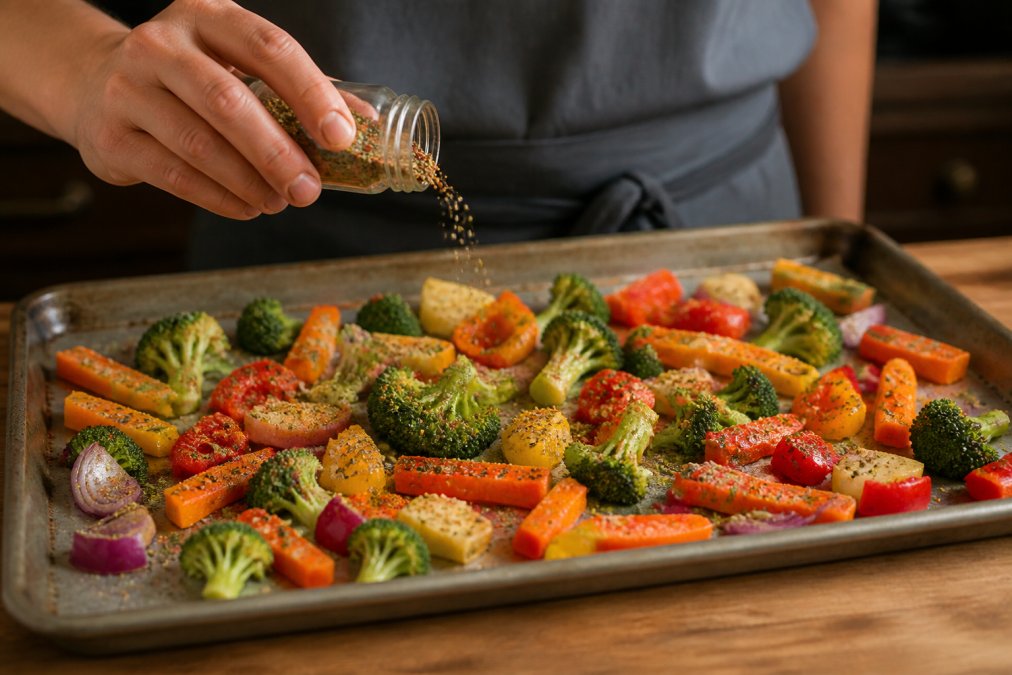
Preheat the Pan for Immediate Sizzle
Place your empty baking sheet in the oven while it pre-heats. When you drop the oiled vegetables onto the hot surface, they start searing immediately, creating a barrier that locks in moisture and prevents sticking.
The sudden contact with high heat vaporizes surface moisture instantly rather than allowing it to pool. A hot pan also means you don't need parchment paper for most vegetables.
Give Each Piece Room to Breathe
Overcrowding is the single biggest cause of soggy roasted vegetables. When pieces touch or overlap, steam gets trapped between them, and the surfaces in contact never brown.
Use two pans if cooking for a crowd. Each piece needs at least a small gap on all sides so hot air can circulate and moisture can escape. If piled on top of each other, the ones on the bottom steam while the ones on top brown unevenly.
Troubleshooting High-Water Vegetables
Zucchini, summer squash, tomatoes, and mushrooms release substantial moisture during cooking. A few extra steps make the difference between caramelized and watery.
Salt these vegetables and let them rest on paper towels for 15 minutes before roasting. This draws out excess water before they hit the oven. You can also roast them at a higher temperature, 450°F, or on a separate rack position closer to the heating element.
Convection vs. Conventional Oven Settings
Convection roasting is the best way to prevent soggy roasted vegetables because the built-in fan circulates hot air, accelerating moisture evaporation and promoting even browning. If your oven has a convection setting, use it and reduce the temperature by 25°F.
The moving air removes the humid boundary layer that forms around roasting vegetables, the same reason food dehydrators use fans. Without convection, you rely on natural air movement, which is slower and less consistent.
For conventional ovens, use a lower rack position and avoid pans with tall sides, which block airflow and trap steam. A flat, open sheet pan with no rim, or a very low rim, allows maximum heat circulation.
Post-Roasting Moisture Management
Moisture management doesn't end when the timer goes off. Vegetables continue to release water after leaving the oven, and stacking them in a covered bowl will undo all your crisp work.
Transfer roasted vegetables to a wire rack or serving dish immediately. Leave space between pieces so steam can dissipate rather than condensing back onto the surface. If roasting in batches, don't pile finished vegetables on top of each other while the next batch cooks.
The broiler is your final tool for rescuing vegetables that didn't crisp enough. After roasting, switch to broil and give the vegetables 1 to 2 minutes of direct high heat. Watch closely, as the line between browned and burned is thin. This works especially well for high-water vegetables needing extra surface drying.
Crispy Roasted Vegetables, Every Time
Crispy roasted vegetables are not about luck or expensive equipment. They come from understanding moisture: how heat drives it off, how spacing allows it to escape, and how seasoning affects its release. Get those fundamentals right, and you'll never settle for mushy vegetables again.
Start with a hot oven, give your vegetables room to breathe, and season them with dry spices rather than wet marinades. When you want bold Southwest flavor without added moisture, Dam Spice Company's all-natural seasoning blends like our Butt Rub or SPG add smoky, savory depth to roasted carrots, potatoes, and cauliflower without introducing water that causes sogginess.
The science here is straightforward: dry heat plus air circulation plus proper spacing equals caramelized edges and tender centers. The Harvard School of Public Health's vegetable cooking guide confirms that dry-heat methods preserve both texture and nutrients better than boiling or steaming.
For more roasting inspiration and spice pairings, explore our Dam Spice Company recipe collection and find blends that work with your favorite vegetables. Your next sheet pan of crispy, golden vegetables is one hot pan away.
Frequently Asked Questions
Why are my roasted vegetables always soggy?
Soggy vegetables are usually the result of overcrowding the baking sheet and an oven temperature that is too low. When vegetables are packed too closely, they release steam instead of roasting, which prevents the Maillard reaction from creating that crispy, golden-brown exterior. Using a lower temperature, like 375°F, can also cause vegetables to cook slowly and release more moisture before they have a chance to brown. Try roasting at 425°F or 450°F in a single layer to fix this.
Should I boil or blanch vegetables before roasting to prevent sogginess?
No, you should skip boiling entirely. Boiling adds moisture to vegetables, which is the opposite of what you want for roasting. Blanching, or briefly boiling then shocking in ice water, is only useful for specific cases like removing the skin from tomatoes or preparing very dense root vegetables. For most vegetables, roasting them raw with a little oil and proper spacing is the best way to achieve a tender-crisp texture without sogginess.
Does overcrowding the pan cause soggy vegetables?
Yes, overcrowding is the number one culprit. When vegetables overlap or touch each other on the baking sheet, they trap steam. This steam condenses back onto the vegetable surfaces, making them mushy rather than crispy. The hot air in the oven cannot circulate properly to evaporate surface moisture and trigger browning. Always use a large baking sheet and spread vegetables in a single layer with a little space between each piece.
What is the best temperature for roasting vegetables to keep them crisp?
The best temperature for roasting vegetables is between 425°F and 450°F. This high heat is crucial because it drives off moisture quickly and encourages browning through the Maillard reaction. Lower temperatures, like 350°F, will cook the vegetables through but leave them soft and potentially soggy. For most vegetables, 425°F is a great balance, while 450°F works well for denser options like potatoes and carrots. Always preheat your oven fully before adding the pan.
Getting soggy roasted vegetables right comes down to heat management, spacing, and smart seasoning choices. At Dam Spice Company, we craft all-natural, additive-free blends made with authentic New Mexico spices that enhance roasted vegetables without adding moisture or fillers. Try our SPG for everyday roasting or Doctor's Choice for a no-salt option, and get started with Dam Spice Company for consistently crisp, flavorful results.