

Best Herb Combinations for Roasted Mediterranean Vegetables
Table of Contents
- Why Herb Combinations Matter for Roasted Mediterranean Vegetables
-
7 Best Herb Combinations for Roasted Mediterranean Vegetables
- 1. Oregano, Thyme, and Rosemary (The Greek-Style Base)
- 2. Basil, Flat-Leaf Parsley, and Garlic (Italian-Style Brightness)
- 3. Dill, Parsley, and Scallions (Lighter, Herbal Finish)
- 4. Rosemary, Thyme, and Black Pepper (Earthy and Savory)
- 5. Oregano, Basil, and Red Pepper Flakes (Pizza-Style Blend)
- 6. Thyme, Dill, and Lemon Zest (Bright and Fragrant)
- 7. Cumin, Oregano, and Smoked Paprika (Southwest Twist)
- Vegetables That Go Well Together for Roasting
- Fresh vs Dried Herbs for Roasting: Which to Use and When
- How to Season Roasted Vegetables: A Step-by-Step Method
- A Simple Mediterranean Roasted Vegetables Recipe
- How to Pair Herbs with Individual Vegetables
- Common Mistakes That Kill Herb Flavor
- Frequently Asked Questions
Last Updated: October 4, 2026
Why Herb Combinations Matter for Roasted Mediterranean Vegetables
The right herb combinations for roasted mediterranean vegetables are the difference between a forgettable side dish and the tray everyone reaches for first.
Roasting concentrates flavor: as vegetables caramelize, their sweetness deepens and herbs must keep pace. Oregano, thyme, and rosemary do; a lone sprinkle of dried basil does not.
Below: seven blends, plus quantities, fresh-to-dried swaps, and a seasoning method.
7 Best Herb Combinations for Roasted Mediterranean Vegetables
Each blend follows the same logic: one herb for backbone, one for brightness, one for aroma. Quantities are for a standard sheet pan holding about 2 pounds of chopped vegetables.
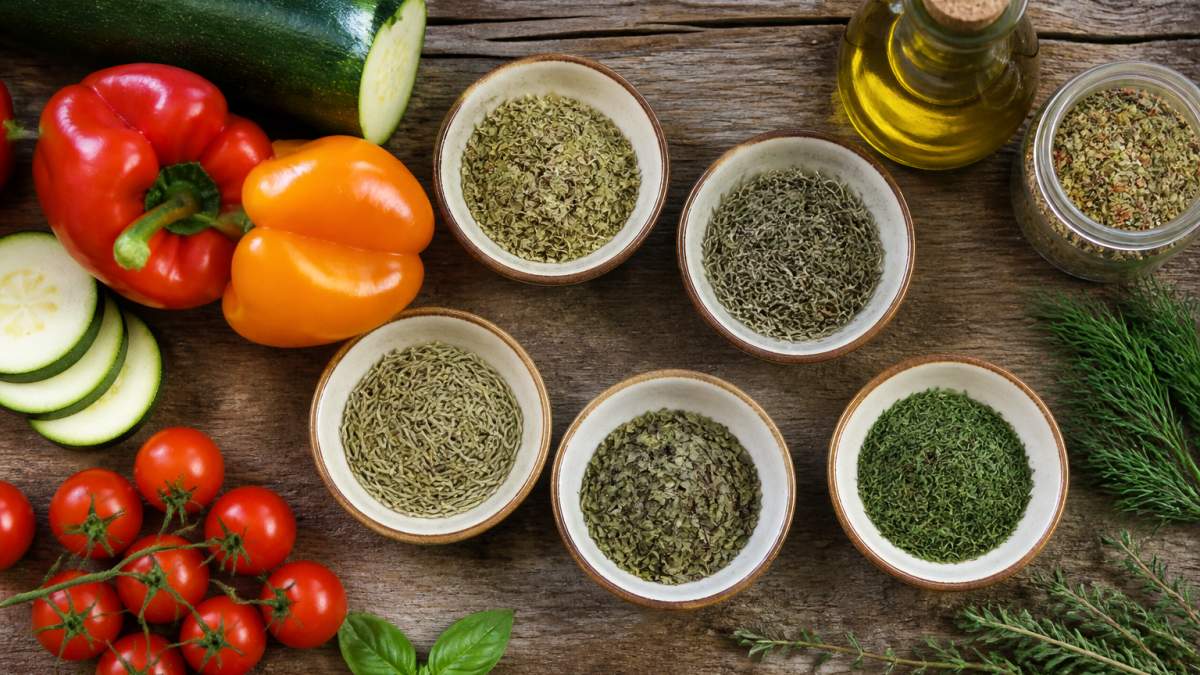
1. Oregano, Thyme, and Rosemary (The Greek-Style Base)
Our workhorse blend. Oregano brings the savory punch of Greek-style roasted vegetables, thyme adds an earthy middle note, and rosemary contributes a piney aroma that survives high heat.
Use 1 teaspoon dried oregano, 1/2 teaspoon dried thyme, and 1/2 teaspoon crushed dried rosemary per sheet pan. Crush the rosemary between your fingers first; whole needles stay tough.
Best with: zucchini, eggplant, bell peppers, and root vegetables.
2. Basil, Flat-Leaf Parsley, and Garlic (Italian-Style Brightness)
Basil and parsley are delicate, so add this blend in the last 5 minutes of roasting, or toss it with the vegetables after they leave the oven.
Use 1 teaspoon dried basil, 1 teaspoon dried flat-leaf parsley, and 2 cloves minced garlic. The garlic needs those final minutes to lose its raw edge.
Best with: cherry tomatoes, bell peppers, and zucchini.
3. Dill, Parsley, and Scallions (Lighter, Herbal Finish)
Dill is the sleeper herb of Mediterranean cooking: it cuts through olive oil's richness and pairs beautifully with anything sweet.
Use 1 teaspoon dried dill, 1 teaspoon dried parsley, and 2 sliced scallions. Sprinkle the scallions raw over the finished tray for crunch.
Best with: carrots, beets, and roasted potatoes.
4. Rosemary, Thyme, and Black Pepper (Earthy and Savory)
When you want vegetables that taste like they came off a grill, this is the blend. Rosemary and thyme are woody herbs that stand up to long roasting without turning bitter.
Use 1 teaspoon dried rosemary, 1 teaspoon dried thyme, and 1/2 teaspoon coarse black pepper. This trio is our pick for root vegetables, where the earthy notes match the sweetness of caramelized carrots and parsnips.
5. Oregano, Basil, and Red Pepper Flakes (Pizza-Style Blend)
If your family likes pizza night, they will like this pizza seasoning applied to vegetables, and it works on far more than zucchini.

Use 1 teaspoon dried oregano, 1 teaspoon dried basil, and a pinch of red pepper flakes. For a shortcut, our Pizza Seasoning already combines Italian herbs, garlic, and mild heat in one jar at $7.99. It is naturally gluten-free with no MSG, no fillers, and no additives.
Best with: bell peppers, cherry tomatoes, and eggplant.
6. Thyme, Dill, and Lemon Zest (Bright and Fragrant)
Acidity is the missing element in most roasted vegetable trays. Lemon zest fixes that, and dill amplifies it.
Use 1 teaspoon dried thyme, 1 teaspoon dried dill, and the zest of one lemon. Add the zest after roasting so the oils stay bright.
Best with: asparagus, zucchini, and cherry tomatoes.
7. Cumin, Oregano, and Smoked Paprika (Southwest Twist)
This is where our New Mexico kitchen shows up: cumin and smoked paprika push vegetables toward smoky, savory territory, while oregano keeps one foot in the Mediterranean.
Use 1/2 teaspoon ground cumin, 1 teaspoon dried oregano, and 1 teaspoon smoked paprika. A squeeze of lime at the end ties it together.
Best with: cauliflower, sweet potatoes, and bell peppers.
Vegetables That Go Well Together for Roasting
Vegetables that go well together for roasting share similar density and water content. Pairing fast-cooking zucchini with dense beet means one turns to mush while the other stays raw.
Group them like this:
- Quick roast (20-25 minutes): zucchini, bell peppers, cherry tomatoes, eggplant
- Medium roast (30-35 minutes): cauliflower, broccoli, mushrooms, red onion
- Long roast (40-45 minutes): carrots, beets, potatoes, parsnips, sweet potatoes
Cut everything to roughly the same size, about 1 inch, and keep dense vegetables in smaller pieces than soft ones. The [USDA's guidance on vegetable storage and handling | usda.gov] is a useful reference if you are unsure how long produce keeps before roasting.
Fresh vs Dried Herbs for Roasting: Which to Use and When
Dried herbs are the better default for roasting, but the reason matters more than the rule.
The practical rule: 1 teaspoon dried replaces 1 tablespoon fresh.
| Herb form | Examples | When to add | Quantity per 2 lb vegetables |
|---|---|---|---|
| Dried, woody | Oregano, thyme, rosemary, sage | Before roasting | 1 tsp total, split across the blend |
| Fresh, woody | Rosemary, thyme, oregano | Before roasting | 1 tbsp total, chopped fine |
| Dried, tender | Basil, parsley, dill, mint | After roasting | 1 tsp total, stirred in while hot |
| Fresh, tender | Basil, parsley, dill, mint | After roasting | 1 tbsp total, torn or chopped |
| Dried blend | Pizza-style, Greek-style | Before roasting | Per jar directions, usually 1 to 2 tsp |
Three timing rules cover almost every case:
- Woody herbs roast from the start. Rosemary, thyme, and oregano have thick leaves and stems that hold up to 40 minutes of dry heat. Crush dried rosemary first, whole needles stay tough and can taste like pine splinters.
- Tender herbs go in after the oven. Basil, parsley, dill, and mint turn black and bitter within minutes at 425°F. Add them the moment the tray comes out, while the vegetables are still hot enough to wilt the leaves and release their oils.
- Garlic is not an herb, but it follows the same logic. Minced garlic burns at 425°F and turns acrid. Add it in the last 5 to 10 minutes, or stir it into the hot vegetables after roasting.
A common pattern: build the tray with a dried woody base, roast, then finish with a fresh tender herb and an acid.
When substituting, work in one direction: start with the fresh quantity, divide by three, and use that much dried.
How to Season Roasted Vegetables: A Step-by-Step Method
Learning how to season roasted vegetables comes down to order of operations: salt first, oil second, herbs third, acid last.
- Dry the vegetables. Pat them with a towel. Wet surfaces steam instead of roast.
- Salt first. Sprinkle 1/2 teaspoon kosher salt per pound and let sit 10 minutes.
- Add oil. Use 2 tablespoons olive oil per sheet pan and toss until every piece shines.
- Add dried herbs. Sprinkle your blend evenly, then toss again with your hands.
- Spread with space. Leave 1/2 inch between pieces. Crowding steams the vegetables.
- Roast at 425°F for 20 to 45 minutes depending on density, flipping once at the halfway mark.
- Finish with acid and tender herbs. A squeeze of lemon or a splash of vinegar wakes everything up.
A Simple Mediterranean Roasted Vegetables Recipe
This Mediterranean roasted vegetables recipe serves 4 to 6 and takes about 40 minutes total.
What you'll need:
- 2 lb mixed vegetables (zucchini, bell peppers, cherry tomatoes, red onion)
- 2 tbsp olive oil
- 1 tsp dried oregano
Method: Heat the oven to 425°F. Chop the vegetables into 1-inch pieces and pat dry. Toss with oil, salt, pepper, and the herb blend until evenly coated.
For a Southwest version, swap the herb blend for cumin, oregano, and smoked paprika, and finish with lime.
How to Pair Herbs with Individual Vegetables
Most articles stop at "oregano goes with zucchini", a starting point, not a pairing system.
Here is the full reference. Quantities are for 1 pound of that vegetable, assuming a 425°F oven and a single layer on a sheet pan.
| Vegetable | Best herb combination | Quantity per 1 lb | Why it works |
|---|---|---|---|
| Zucchini | Oregano + thyme + basil | 1/2 tsp oregano, 1/4 tsp thyme, 1/2 tsp basil (added after roasting) | High water content dilutes flavor, so it needs a savory anchor plus a bright finish |
| Eggplant | Oregano + rosemary + smoked paprika | 1/2 tsp oregano, 1/4 tsp rosemary, 1/2 tsp paprika | Eggplant's spongy flesh absorbs oil and smoke; rosemary's piney notes cut the bitterness |
| Bell peppers | Oregano + basil + cumin | 1/2 tsp oregano, 1/2 tsp basil, 1/4 tsp cumin | Sweetness rises as peppers caramelize; cumin adds an earthy counterweight |
| Cherry tomatoes | Basil + oregano + thyme | 1/2 tsp basil, 1/2 tsp oregano, 1/4 tsp thyme | Tomatoes blister and concentrate; basil's anise note mirrors their natural sweetness |
| Red onion | Thyme + rosemary + black pepper | 1/2 tsp thyme, 1/4 tsp rosemary, 1/4 tsp pepper | Onion turns jammy; woody herbs hold up to the long roast and match the caramelized sugars |
| Mushrooms | Thyme + parsley + garlic | 1/2 tsp thyme, 1/2 tsp parsley (after roasting), 1 clove minced garlic (last 5 min) | Mushrooms release water and brown deeply; thyme's earthiness mirrors their umami |
| Broccoli | Oregano + red pepper flakes + lemon zest | 1/2 tsp oregano, pinch of flakes, zest of 1/2 lemon | Bitter crucifers need brightness and heat to balance the sulfur notes |
| Cauliflower | Cumin + smoked paprika + thyme | 1/2 tsp cumin, 1/2 tsp paprika, 1/4 tsp thyme | Cauliflower is neutral; cumin and paprika give it a smoky backbone |
| Carrots | Rosemary + thyme + dill | 1/2 tsp rosemary, 1/2 tsp thyme, 1/2 tsp dill (after roasting) | High sugar content wants earthy herbs; dill's freshness keeps it from tasting like dessert |
| Beets | Thyme + dill + black pepper | 1/2 tsp thyme, 1/2 tsp dill, 1/4 tsp pepper | Beets are sweet and earthy; dill's brightness lifts the soil notes |
| Potatoes | Rosemary + thyme + garlic | 1/2 tsp rosemary, 1/2 tsp thyme, 2 cloves minced garlic (last 5 min) | Starch needs assertive, woody herbs that survive a 40-minute roast |
| Asparagus | Thyme + dill + lemon zest | 1/2 tsp thyme, 1/2 tsp dill, zest of 1/2 lemon | Thin spears cook fast; delicate herbs and citrus keep them from tasting grassy |
Three rules drive every row above:
- Sweet vegetables get earthy herbs. Carrots, beets, sweet potatoes, and onions caramelize into sugar, so rosemary, thyme, and cumin keep them from tipping into candy territory.
- Bitter vegetables get bright herbs. Broccoli, cauliflower, and eggplant need oregano, lemon zest, or red pepper flakes to balance the bitterness.
- Watery vegetables get more herb, not less. Zucchini, tomatoes, and mushrooms release liquid in the oven, which dilutes seasoning. Use the full quantity listed and add tender herbs after roasting.
If you are roasting a mix, pick one vegetable from each density group and use the blend that appears most often across your picks.
Common Mistakes That Kill Herb Flavor
The biggest mistake is adding dried herbs at the end. They need heat and oil to rehydrate and release their oils, so they belong on the vegetables before they go in the oven.
Other mistakes we see often:
- Using stale herbs. Dried herbs lose potency after about a year. Crush a pinch and smell it; if there is no aroma, there is no flavor.
- Skipping the toss. Sprinkling herbs on top of a tray seasons only the top layer. Toss in a bowl first.
- Overcrowding the pan. Vegetables that touch steam instead of roast, and steamed vegetables taste flat no matter what you season them with.
For a head start, our Pizza Seasoning and Hot Pizza Seasoning both run $7.99 and cover the Italian-style blend in one shake; the hot version adds cayenne for medium heat. The Pizza Seasoning Sample and Hot Pizza Seasoning Sample are $0.50 each, so you can test a blend before committing to a full jar.


Roasting vegetables well is mostly about timing, and herb blends are the easiest part to get right once you know the order of operations. Dam Spice Company makes that step simpler with all-natural blends crafted in New Mexico, no additives, no MSG, and naturally gluten-free.
Frequently Asked Questions
What herbs go with Mediterranean vegetables?
Oregano, thyme, rosemary, and basil are the core herbs for Mediterranean roasted vegetables. Oregano brings earthy warmth, thyme adds a subtle lemony note, rosemary contributes pine-like depth, and basil offers a sweet, fragrant finish. Dill and flat-leaf parsley work well for lighter dishes. For a Southwest twist, add cumin and smoked paprika to oregano. A pre-mixed Italian-style seasoning like Dam Spice Company's Pizza Seasoning ($7.99) combines oregano, garlic, and spices for a convenient shortcut.
Should you use fresh or dried herbs for roasted vegetables?
Both work, but they behave differently. Dried herbs are more concentrated and hold up better during high-heat roasting, so add them before the vegetables go in the oven. Use about one-third the amount of dried herbs compared to fresh. Fresh herbs, especially basil, parsley, and dill, lose flavor when roasted, so sprinkle them on after the vegetables come out of the oven. Rosemary and thyme are sturdy enough to roast fresh.
When should you add fresh herbs to roasted vegetables?
Add fresh herbs after roasting, once the vegetables are out of the oven and still hot. The residual heat will release their oils without cooking them down to bitterness. For basil, parsley, dill, and scallions, a quick toss right before serving preserves their bright, fragrant character. If you want some herb flavor to penetrate, you can add a small amount of sturdy fresh herbs like rosemary or thyme before roasting, then finish with delicate herbs after.
Can you use rosemary and oregano together on roasted vegetables?
Yes, rosemary and oregano are a classic pairing. Rosemary's piney, earthy notes complement oregano's warm, slightly bitter flavor. Use them together on root vegetables like potatoes, carrots, and onions, or on zucchini and eggplant. A good ratio is two parts oregano to one part rosemary, since rosemary can overpower. Add minced garlic and olive oil, then roast at 425°F until caramelized.
What are some examples of Mediterranean herb combinations?
Popular combinations include Greek-style (oregano, thyme, rosemary), Italian-style (basil, parsley, garlic), and lighter blends (dill, parsley, scallions). For a smoky profile, try cumin, oregano, and smoked paprika. Each blend suits different vegetables: Greek-style works on eggplant and zucchini, Italian-style shines on tomatoes and bell peppers, and dill blends pair well with root vegetables. Dam Spice Company's Hot Pizza Seasoning ($7.99) adds cayenne to the Italian trio for gentle heat.