

Healthy Low Sodium Vegetable Seasoning Blends That Taste Bold
Table of Contents
- Why Your Vegetables Need a Low Sodium Vegetable Seasoning Makeover
- How to Season Vegetables Without Salt: The Flavor Framework
- The Best Herbs for Roasted Vegetables: A Pairing Guide
- Salt-Free Seasoning Recipes You Can Make in 5 Minutes
- What to Look for in Store-Bought Low Sodium Vegetable Seasoning
- Potassium-Based Substitutes vs. Herb Blends: Which Wins?
- Budget-Friendly Bulk Buying and Spice Shelf-Life
- Conclusion: Make the Switch to Bold, Salt-Free Flavor
- Frequently Asked Questions
Last Updated: September 9, 2026
Why Your Vegetables Need a Low Sodium Vegetable Seasoning Makeover
The average American consumes far more sodium than recommended, much of it hiding in processed foods and, surprisingly, the "healthy" vegetable dishes you make at home. A healthy low sodium vegetable seasoning blend is the difference between a side dish that sabotages your blood pressure goals and one that supports a heart-healthy diet. At Dam Spice Company, we craft all-natural, additive-free blends in New Mexico, and swapping the salt shaker for bold, herb-driven seasoning can transform both the plate and the palate.
Most guides treat salt-free cooking as a subtraction problem: take away the salt and hope the vegetables still taste good. That approach fails. The real fix is an addition problem, where you build a flavor profile with aromatic spices, savory herbs, and citrus notes that make salt irrelevant. Below, we show you how to season vegetables without salt using a framework that works across every vegetable you roast, grill, or sauté, plus DIY recipes that take five minutes to mix.
How to Season Vegetables Without Salt: The Flavor Framework
The most effective way to season vegetables without salt is to layer three flavor components: a savory base, a pungent accent, and a bright finishing note. Salt amplifies existing flavors, so when you remove it, you need ingredients that bring their own intensity.
Start with fat and heat. A high-heat oil like avocado or grapeseed helps spices bloom and coats vegetables evenly, which matters more than the specific herbs you choose. Then apply your base layer before roasting so the flavors penetrate rather than just coat the surface.
Build a Base: Onion, Garlic, and Smoked Paprika
A reliable low sodium vegetable seasoning starts with granulated onion and garlic for savory depth, then adds smoked paprika for earthy undertones and a subtle, smoky sweetness that mimics the satisfaction salt provides. These three ingredients form the backbone of most successful salt-free blends because they deliver umami.
Granulated forms work better than powders here. Granules distribute evenly without clumping and resist burning at roasting temperatures. Toasted garlic powder adds a deeper, almost nutty character, though standard garlic powder performs well in most applications. This base layer is versatile enough for a dry rub on portobello mushrooms or a simple toss with cauliflower steaks.
The Best Herbs for Roasted Vegetables: A Pairing Guide
Most pairing guides stop at "rosemary goes with potatoes." That tells you what to use, but not why it works, or when it fails. The real driver of a successful pairing is the vegetable's water content, natural sugar profile, and sulfur compounds.
The Chemistry of the Pairing
Cruciferous vegetables (broccoli, cauliflower, Brussels sprouts, cabbage) contain glucosinolates, sulfur-containing compounds that break down during cooking into bitter byproducts. High heat, 425°F or higher, drives off moisture and allows browning to create savory, nutty flavors that mask bitterness (peer-reviewed research). Pair with smoked paprika, chili powder, and ground coriander, whose volatile oils complement the sulfur notes. A squeeze of lemon or citric acid after roasting also helps neutralize bitterness.
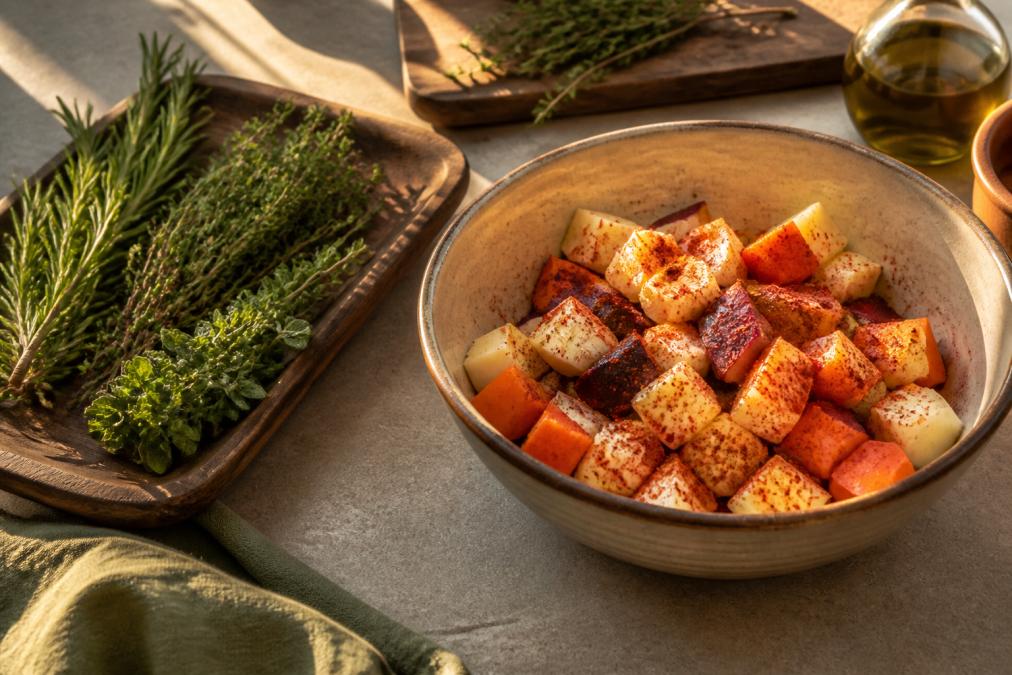
Root vegetables (carrots, parsnips, beets, potatoes) are starch-heavy and naturally sweet. Their cellular structure holds up to long roasting times, so woody herbs like rosemary and thyme have time to infuse without burning. Tossing them in oil with whole or roughly chopped herbs before roasting yields more even flavor than ground herbs, which can clump.
Watery vegetables (zucchini, yellow squash, eggplant, mushrooms) are the hardest to season because their high moisture content dilutes flavors and causes steaming instead of roasting. Pat them dry before oiling, and use concentrated, oil-soluble flavors. Ground cumin, coriander, and smoked paprika adhere better than fresh herbs. For mushrooms, a dry rub with mustard powder and garlic granules works especially well.
A Decision Tree for Any Vegetable
Instead of a static chart, use this quick logic:
- Is it a green vegetable? Start with garlic and a citrus note (lemon zest or a pinch of citric acid). Add chili flakes for heat. Finish with fresh herbs after roasting, not before.
- Does it grow underground? Reach for woody herbs (rosemary, thyme, oregano) plus a warm spice like cumin or smoked paprika. Roast hot and long to caramelize natural sugars.
- Is it a summer squash or mushroom? Dry it thoroughly, then use ground spices with a smoky or pungent profile. Avoid fresh herbs until the last minute of cooking.
- Is it a sweet pepper or tomato? These are already high in umami and natural sugars. A light touch of garlic powder and black pepper is often enough; heavy spice blends can overwhelm their flavor.
The One Mistake That Ruins Every Pairing
The most common error is seasoning vegetables before they are fully dry. Water on the surface steams the vegetables, preventing browning and diluting the spice coating. After washing, spin or pat vegetables dry, toss them in oil first, then add your seasoning blend. The oil acts as a glue for the spices and ensures even coverage.
A Note on Fresh vs. Dried Herbs
Dried herbs are more concentrated than fresh, so they work better in blends applied before roasting. Fresh herbs have higher water content and more delicate volatile oils; they burn at roasting temperatures. Add fresh rosemary or thyme in the last five minutes of roasting or as a finishing sprinkle. Hearty fresh herbs like sage can withstand higher heat for short periods.
For a practical application: for every pound of prepared vegetables, use one tablespoon of a dried herb-based blend, one to two tablespoons of oil, and a pinch of acid (citric acid powder or lemon zest) applied after cooking. This ratio works across all vegetable types.
Salt-Free Seasoning Recipes You Can Make in 5 Minutes
These salt-free seasoning recipes take less time than finding your salt shaker, and they keep for months in an airtight jar. Each makes roughly a quarter cup.
Southwest Citrus Zest Blend
Combine two tablespoons of smoked paprika, one tablespoon of granulated onion, one teaspoon of garlic powder, one teaspoon of dried orange zest, and half a teaspoon of ground cumin. The citrus notes brighten roasted carrots and sweet potatoes, while the smoked paprika delivers signature New Mexico warmth. This blend also works as a finishing sprinkle on avocado toast or popcorn.
Smoky Umami Dry Rub for Grilled Vegetables
Mix one tablespoon of smoked paprika, one tablespoon of granulated garlic, one teaspoon of mustard powder, one teaspoon of dried thyme, and half a teaspoon of black pepper. Mustard powder adds a tangy, pungent kick that stands in for salt's sharpness. This dry rub excels on grilled portobello caps, zucchini planks, and eggplant slices.
What to Look for in Store-Bought Low Sodium Vegetable Seasoning
When buying a prepared low sodium vegetable seasoning, the two critical factors are the ingredient list and the serving size on the nutrition label. Many blends labeled "low sodium" still contain significant amounts per teaspoon, and others hide sodium in forms like celery salt or MSG.
The FDA's Definition of "Low Sodium" and What It Means for You
The FDA regulates nutrient content claims. For a product to bear the "low sodium" label, it must contain 140 mg or less of sodium per serving (per 21 CFR 101.61) (ecfr.gov). The loophole is the serving size. A blend with 140 mg per 1/4 teaspoon is technically "low sodium," yet most home cooks use a full teaspoon or more per dish, quadrupling the sodium to 560 mg, nearly a quarter of the American Heart Association's recommended daily limit of 2,300 mg.
The FDA also allows "no salt added" claims, but this only means no salt was added during processing, it does not guarantee the product is sodium-free. Ingredients like celery powder, onion powder, or natural flavorings can contribute sodium without appearing on the label as "salt."
Hidden Sodium Sources: The Ingredients That Trick You
Scan the ingredient list for these specific sodium carriers:
- Celery powder or celery seed, Celery naturally contains sodium, and concentrated celery powder can pack as much sodium per gram as table salt.
- Monosodium glutamate (MSG), MSG contains about 12% sodium by weight; a teaspoon has roughly 200 mg.
- Onion salt or garlic salt, Simply granulated onion or garlic mixed with salt.
- Disodium inosinate or disodium guanylate, Flavor enhancers often paired with MSG that contain sodium.
- Baking soda (sodium bicarbonate), Used as an anti-caking agent or pH adjuster; it adds sodium.
The Fillers and Additives That Dilute Flavor
Beyond sodium, look for fillers that pad the blend without adding flavor:
- Silicon dioxide, An anti-caking agent, generally recognized as safe (GRAS) by the FDA, but its presence signals a heavily processed product.
- Maltodextrin, A starch-derived filler that adds bulk and can spike blood sugar.
- Sugar or dextrose, Added sweetness can mask bitterness but adds empty calories and can caramelize unevenly.
- Calcium stearate, An anti-caking agent that can leave a chalky mouthfeel.
A truly clean blend should list only spices and herbs. Whole food ingredients like onion, garlic, paprika, and mustard deliver concentrated flavor without additives. The FDA requires ingredients listed in descending order by weight, so if a filler appears in the top three, the blend is mostly filler.
How to Read the Nutrition Label in 30 Seconds
- Check the serving size first. Is it 1/4 teaspoon, 1/2 teaspoon, or 1 teaspoon?
- Multiply the sodium per serving by how much you actually use. If you use 2 teaspoons and the serving size is 1/4 teaspoon, multiply the sodium by 8.
- Look at the % Daily Value. The FDA bases this on a 2,000-calorie diet with a 2,300 mg sodium limit. If a blend has 5% DV per serving, that is 115 mg, fine for a pinch, but not for a generous coating.
- Scan the ingredient list for hidden sources. If you see celery powder or disodium anything, put it back.
The "No Salt Added" Trap
A product labeled "no salt added" can still have naturally occurring sodium from ingredients like celery powder or sea vegetables (kelp, dulse). The FDA only requires that no salt was added during processing. Always verify with the nutrition label, not the front-of-package claim.
A Practical Test: The Taste Check
Before committing to a full bottle, do a side-by-side test. Sprinkle the blend on a plain roasted potato and taste it alone. A quality low-sodium blend should have immediate aromatic impact, you should smell garlic, paprika, or citrus before it hits your tongue. If the first thing you taste is dusty or starchy, the blend is likely heavy on fillers. If it tastes flat until you add salt, it lacks the umami-rich ingredients that stand in for salt's flavor-enhancing role.
Dam Spice Company's Doctor's Choice No Salt blend combines onion, garlic, mustard, paprika, and spices for a rich, well-balanced profile that works on everything from eggs to roasted vegetables, and it contains no additives of any kind. You can try it for just $0.50 with a sample size, or grab the full 8 oz bottle for $7.99.


Potassium-Based Substitutes vs. Herb Blends: Which Wins?
Potassium-based salt substitutes, which replace sodium chloride with potassium chloride, taste closer to salt than any herb blend, but they carry a metallic bitterness that many palates never fully accept, and they are unsafe for people with kidney disease or those taking certain blood pressure medications.
Herb-based blends do not try to imitate salt; they replace the entire flavor experience with aromatic complexity. The trade-off is real: herb blends require a palate adjustment period of roughly two to four weeks. After that, most people find the richer flavor profile more rewarding than plain salted vegetables ever were.
For anyone managing hypertension under medical supervision, herb blends avoid the risks associated with potassium chloride. The American Heart Association guidance on salt substitutes notes that potassium-based substitutes are not appropriate for everyone, making whole-food herb blends a safer default for most home cooks.
Budget-Friendly Bulk Buying and Spice Shelf-Life
Buying spices in bulk saves money, but only if you store them properly and use them before they lose potency. Ground spices retain peak flavor for about six months to a year; whole spices last two to three years when kept away from light, heat, and moisture.
Store your salt-free seasoning blends in airtight glass jars in a cool, dark cabinet. Avoid keeping them above the stove, where heat degrades volatile oils quickly. A simple test for freshness: if a blend smells more like dust than its original aromatic character, it has lost its flavor and should be replaced.
Bulk buying works best for the spices you use weekly, not the ones you reach for twice a year. Buy larger quantities of smoked paprika, granulated garlic, and cumin if you roast vegetables regularly, since these form the backbone of most low sodium vegetable seasoning recipes. For pricier items like dried citrus zest or specialty chiles, smaller quantities make more sense.
Conclusion: Make the Switch to Bold, Salt-Free Flavor
The challenge of cooking without salt is not a lack of flavor options; it is breaking the habit of reaching for the shaker out of convenience. A well-stocked spice rack and a few reliable blends turn that moment of habit into an opportunity for creativity. Dam Spice Company offers Doctor's Choice No Salt to provide bold, savory flavor. Get started with Dam Spice Company and experience how satisfying heart-healthy vegetables can be.
Frequently Asked Questions
What is a good low-sodium seasoning for veggies?
A good low sodium vegetable seasoning blend combines aromatic alliums like onion and garlic with warm spices such as smoked paprika, mustard, and celery seed. These ingredients add savory depth and a touch of heat without relying on salt. Look for blends that are MSG-free and gluten-free, and check the nutrition label to confirm sodium is low per serving. Doctor's Choice from Dam Spice Company is a solid option, delivering that savory kick to roasted or sauteed vegetables.
How do I make veggies taste good without salt?
The trick is to build flavor in layers. Start by roasting vegetables at high heat to bring out their natural sweetness. Then, toss them with a fat like olive oil, which carries fat-soluble flavors. Finally, season generously with a salt-free mix of herbs and spices. Use smoked paprika for a meaty, umami note, garlic and onion powder for savoriness, and a pinch of citrus zest to brighten the final dish. A squeeze of lemon after cooking also mimics the pop that salt usually provides.
Are store-bought spice blends usually high in sodium?
Many are, because salt is a cheap filler that bulks up the product. The first ingredient on the label is often salt, or the blend lists 'salt' before any spices. To avoid this, always check the nutrition label for sodium content per serving. A blend that lists spices first and has zero milligrams of sodium is your safest bet. Be wary of 'seasoned salt' products, which are mostly salt with a little spice, and watch for hidden sources of sodium like MSG or sodium diacetate.
What seasoning tastes like salt but is not salt?
No single herb perfectly mimics salt, but you can create a salty sensation using a mix of techniques. Nutritional yeast offers a savory, cheesy flavor some find salty. Potassium chloride is a direct salt substitute, but it can taste metallic and bitter, especially when heated. For a more balanced approach, combine garlic powder, onion powder, and a touch of citric acid. The acid triggers the same taste receptors as salt, adding brightness that makes the flavors pop without the sodium.